
Founder
Safiye Gümüş Şahan
Financier. Trader. The woman who went looking for goods and found craft.
Safiye Gümüş Şahan spent two decades in finance, accounting, and international trade — buying, selling, moving things across borders. She understood supply chains, margins, and the arithmetic of commerce. What she couldn’t account for was the question of what those things carried with them.
Every object that crosses a border carries a story. Most supply chains are designed to erase that story — to standardise, to anonymise, to make everything interchangeable. Safiye spent two decades watching this happen. Navohi is what she decided to do about it.
She is based between İzmir and İstanbul, and travels constantly — to Lagos, to Kyoto, to Oaxaca, to Tokat — to find artists whose visual language is rooted in a place, a tradition, a way of seeing that no algorithm could replicate. She brings that language to silk from Şeki, Azerbaijan. She is particularly committed to amplifying women artists and artisans whose work is too often invisible to the world beyond their own community.
The journey that started everything
She went looking for silk. She found something older.
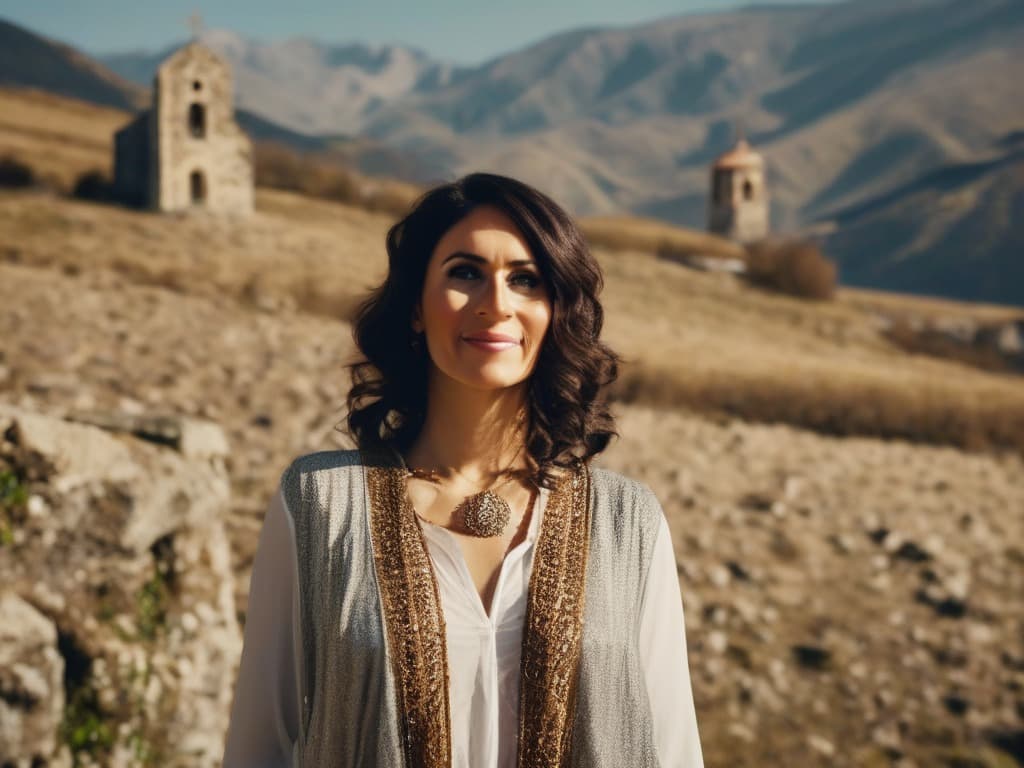
Kiş village, Azerbaijan. The Albanian Church is considered the oldest Christian structure in the Caucasus, dating to the 1st century AD.
In her own words
“I spent twenty years in trade learning how the world moves goods from one place to another. I spent those same years watching those goods lose their story somewhere in the supply chain. Navohi is my attempt to build a supply chain that the story survives.”
“The kelaghayi masters of Şeki do not write their technique down. They never have. The knowledge lives in the hands, transmitted from grandmother to granddaughter by touch. When I first watched Narmin Hasanova press a galib into silk, I understood what I had been missing in twenty years of finance: the value of the thing that cannot be documented.”
“I am not trying to save a tradition. Traditions don’t need saving — they need an audience. My job is to find the audience for people whose work has always deserved one.”
— Safiye Gümüş Şahan
The name
NAVOHI
Navohi comes from the Persian navā — melody, voice, the sound that carries. It is the pen name of Alisher Navoi, the 15th-century Timurid poet who, at a time when Persian was the language of literature and power across Central Asia, chose to write in Chagatai Turkic — arguing that the vernacular could hold the same literary weight as the court tongue. He became the voice of a people who had not yet written themselves down. Navohi the brand makes the same choice: the material that comes from the valley, the technique that was never written down, the artist who learned from her grandmother. The specific over the generic. The rooted over the universal. The voice that carries what would otherwise be lost.
Are you an artist?
Navohi is always looking for artists whose work is rooted in a place, a tradition, a material — whose visual language was not invented but inherited and deepened. If that is you, Safiye would like to hear from you.
Submit Your Work →